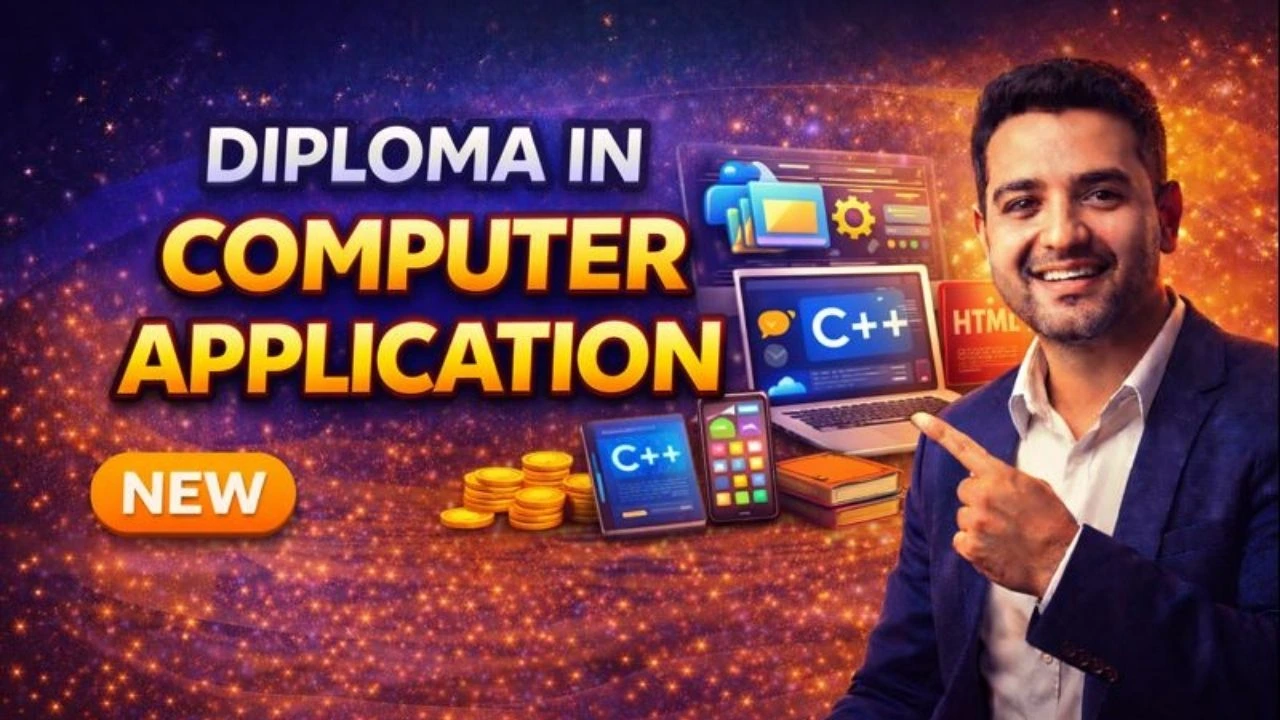
About the Course
Duration: Typically 1 year (full-time) or 1–2 years depending on institute and internship option.
Eligibility: 10+2 or equivalent (varies by institute).
Mode: Classroom + lab practical’s; can include blended or online modules.
Assessments: Quizzes, lab assignments, module tests, project evaluation, internal viva/practical exam.
Core modules / topics
- Computer Fundamentals & OS — hardware, operating systems (Windows, Linux basics), file systems.
- Office Productivity — MS Office suite / Google Workspace: Word, Excel (formulas & charts), PowerPoint.
- Programming Fundamentals — problem solving, algorithms, and one primary language (Python or Java) — variables, control flow, functions.
- Web Technologies — HTML, CSS, JavaScript basics, building simple responsive sites.
- Database Management — relational databases, SQL, basic normalization, CRUD operations.
- Software Tools & Version Control — Git basics, IDEs, debugging.
- Networking & Internet — TCP/IP basics, LAN setup, DHCP, DNS, basic router/switch concepts, network troubleshooting.
- System Administration & Security Basics — user management, backups, antivirus, basic hardening.
- Electives / Applied Topics — PHP & MySQL, mobile app intro, basics of cloud services, data analytics intro (pandas).
- Capstone Project & Internship — build a small real-world application or website; optional short industry internship.
Learning outcomes
- Create and manage documents, spreadsheets, and presentations professionally.
- Write, test, and debug simple programs and scripts.
- Design simple relational databases and perform SQL queries.
- Build a basic responsive website and deploy it (local or simple hosting).
- Perform basic network setup/troubleshooting and system administration tasks.
- Deliver a project demonstrating end-to-end software/application skills.
5 Career Opportunities
1) Junior Software / Application Developer — Start building real applications
What you’ll do: Write, test, and maintain code for small applications or modules.
Key skills from course: Programming fundamentals, version control, basic OOP, debugging.
Entry path: Start as a trainee or junior developer; progress to full developer roles with experience and projects.
2) Web Developer (Front-end / Full-stack – Entry) — Build and maintain websites
What you’ll do: Create responsive websites, maintain web pages, connect front-end to databases.
Key skills from course: HTML/CSS/JS, basic backend (PHP/Node/Python), SQL, deployment fundamentals.
Entry path: Freelance or join agencies/startups as junior web dev; portfolio (capstone project) matters.
3) Database / SQL Operator / Data Assistant — Manage and query data
What you’ll do: Design simple databases, run queries, prepare reports, support data-driven tasks.
Key skills from course: SQL, data modelling basics, CSV/JSON handling, Excel for reporting.
Entry path: Roles in small firms, data-entry-heavy teams, and analytics support positions.
4) IT Support / Helpdesk / System Administrator (Junior) — Keep systems running
What you’ll do: Troubleshoot desktops, manage user accounts, install software, maintain backups, basic network fixes.
Key skills from course: OS administration, networking basics, security fundamentals, troubleshooting workflows.
Entry path: Entry-level IT support roles in corporates, educational institutes, MSPs (managed service providers).
5) QA / Test Engineer (Entry-level) — Improve software quality
What you’ll do: Execute test cases, report bugs, write simple automation scripts for regression testing.
Key skills from course: Logical thinking, scripting basics, use of debugging tools, understanding of SDLC.
Entry path: Start as a QA tester, move to automation with additional learning (Selenium, pytest).