About the Course
Duration: 3–6 months (short-term professional certification).
Eligibility: 10+2 / equivalent or working professionals seeking programming skills.
Mode: Classroom, online, or blended with hands-on labs.
Assessments: Module quizzes, coding assignments, timed practical exams, and a capstone project.
Core modules / topics
- Programming Fundamentals — variables, control flow, data types, operators.
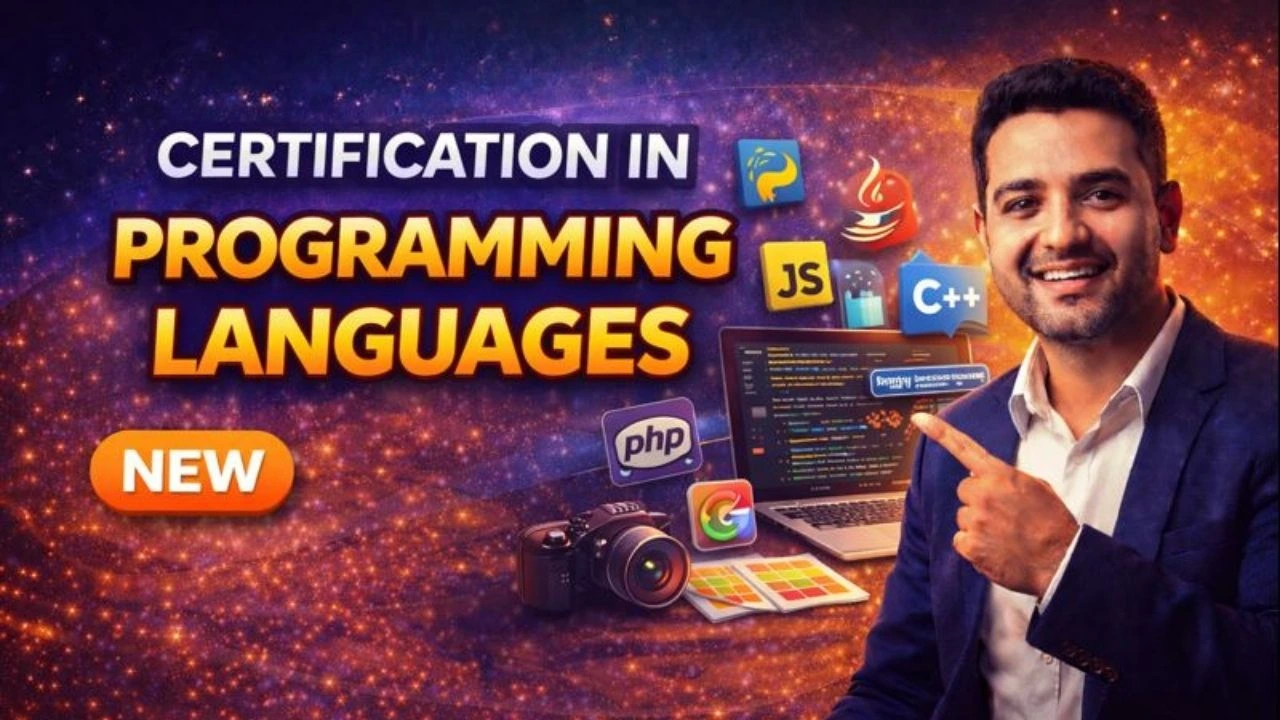
- Language Tracks — hands-on modules in Python, Java, C/C++, and JavaScript (choose 2–3).
- Object-Oriented Programming — classes, inheritance, encapsulation, polymorphism.
- Data Structures & Algorithms (Intro) — arrays, lists, stacks, queues, basic searching/sorting.
- Web Basics — JS fundamentals, DOM, simple backend concepts (APIs).
- Databases & SQL — CRUD operations, simple joins, using DB from code.
- Version Control & Tooling — Git, IDE usage, debugging tools.
- Testing & Debugging — unit tests, logging, common debugging patterns.
- Software Development Best Practices — code organization, documentation, coding standards.
- Capstone Project — build and present a small application using chosen languages.
Learning outcomes
- Write clean, working programs in selected languages.
- Apply OOP and basic data structures to solve problems.
- Connect applications to databases and call simple APIs.
- Use Git and debugging tools for development workflow.
- Implement basic tests and follow coding best practices.
- Deliver a functioning capstone application demonstrating applied skills.
5 Career Opportunities
1) Junior Software Developer — Build and maintain application code
What you’ll do: Implement features, fix bugs, collaborate on small projects.
Key skills from course: Language fluency, OOP, basic algorithms, Git.
Entry path: Join startups, small firms, or internal dev teams as trainee/junior.
2) Front-end / Web Developer (Entry) — Develop interactive web interfaces
What you’ll do: Create responsive UI, work with JavaScript and DOM, integrate APIs.
Key skills from course: JavaScript fundamentals, basic web APIs, debugging.
Entry path: Freelance projects, agencies, or junior front-end roles.
3) Automation / Test Engineer (Entry-level) — Automate tests and build scripts
What you’ll do: Write test scripts, automate repetitive tasks, validate software behavior.
Key skills from course: Scripting (Python/JavaScript), unit testing, debugging.
Entry path: QA teams, test automation roles, or quality support positions.
4) DevOps / Scripting Assistant — Support deployments and automation
What you’ll do: Write scripts for automation, assist in CI/CD tasks, maintain build scripts.
Key skills from course: Scripting, Git, basic tooling, interaction with APIs.
Entry path: Junior roles in operations teams or support for DevOps engineers.
5) Database / Application Support Engineer — Maintain apps and data workflows
What you’ll do: Troubleshoot applications, run queries, support production issues.
Key skills from course: SQL, application debugging, reading codebases.
Entry path: Entry-level support desks, application operations, or junior DBA assistant.